
Injection Molding vs. 3D Printing: Why Material Values Are Not 1:1 Comparable
Why a material from conventional manufacturing does not automatically match the same material name in 3D printing, and what to look for when comparing material data.
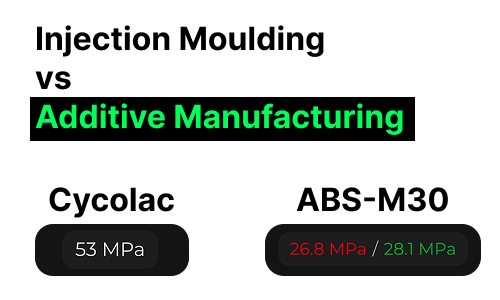
In practice, material data is often treated as directly equivalent too quickly: if both sides say "ABS," people assume the properties are the same. This is exactly where many material selection mistakes begin.
There are fundamental differences between conventional manufacturing processes such as injection molding and additive manufacturing processes (3D printing): in how parts are produced, in internal part structure, and in the resulting mechanical properties.
Same Material Name, Different Reality
A plastic material name describes a material family, but it does not automatically represent the same performance level across different manufacturing processes.
- An ABS for injection molding is not automatically equivalent to an ABS for 3D printing.
- Depending on process, process window, and feedstock form (filament, powder, resin), a different 3D printing material may match injection-molded ABS target values better.
- That is why selection should always be based on concrete property values, not only on the material name.
Why Additive Processes Produce Different Properties
Conventional processes such as injection molding typically produce a very homogeneous part structure. In 3D printing, parts are built layer by layer. This layered structure directly affects material behavior.
Many 3D printing processes are anisotropic. This means:
- Mechanical properties are not the same in every direction.
- In the X/Y direction (in-plane), higher values are often measured.
- In the Z direction (between layers), lower values are often measured.
That is why the table and material pages often include two values: typically a higher value for X/Y and a lower value for Z.
Comparing Material Data: What to Check
For a reliable comparison, property values must always be interpreted in context:
- Manufacturing process: Injection molding data and 3D printing data are only directly comparable to a limited extent.
- Test direction: Orientation is especially critical for additive materials.
- Test method / standard: Different test methods can produce different results.
- Test conditions: Conditioning, temperature, humidity, and specimen geometry influence values.
Data Source in HexaSheets
All values in HexaSheets are based on original manufacturer datasheets. This creates a reliable foundation for preselection.
Still, direct comparisons should always account for the underlying test methods. If standards, conditions, or specimen definitions differ, values are only comparable to a limited degree.
Conclusion
An "ABS" is not automatically the same "ABS" across all manufacturing processes. Anyone comparing injection molding and 3D printing fairly must look beyond the material name and include process context, test direction, and test standards.
A structured material database is important for exactly this reason: it makes differences visible and helps select materials based on real requirements instead of name similarity.